Great Theatre of Ephesus
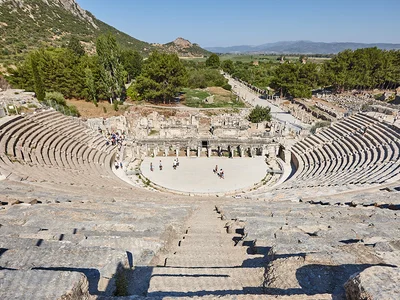
The Great Theatre is a large open-air theatre built into the slope beside Harbour Street. Its seating capacity is commonly estimated at roughly 24,000 spectators, although ancient capacity figures should be treated as estimates rather than exact counts.
Originating in Hellenistic times, the theater underwent significant expansion during the Roman era under Emperor Claudius (41–54 AD). Notable enhancements included the construction of a two-storey stage (skene) during the reign of Emperor Nero (54–68 AD), with a third storey added later in the mid-2nd century. The completion of its construction occurred under Emperor Trajan (98–117 AD). Notably, an aqueduct was engineered in the early 2nd century AD to supply water to Ephesus, with its trajectory necessitating a channel through the upper seats for the Trajan nymphaeum.
This theater, a blend of Hellenistic and Roman design, underwent seismic events and subsequent repairs throughout its history. While often associated with St. Paul's visit to Ephesus, historical evidence suggests he did not preach there during the unrest.
Excavations began before WWI, with extensive restoration efforts undertaken later. The theater remains a testament to Ephesus' rich cultural heritage, attracting visitors from around the world.